A citizen developer is an employee who builds apps, workflows, or automations for the business without being a professional software developer. They use low-code or no-code tools that IT has approved, and they build because they know the process better than anyone. Citizen development is the practice of organizing that work so it is fast, useful, and safe. This guide explains who qualifies, what they build, what training looks like, where the risks are, and when it makes more sense to hand a job to specialists.
TL;DR
- A citizen developer is a business user, not a programmer, who builds applications or automations on IT-sanctioned low-code/no-code platforms.
- Anyone who knows a process well and is willing to learn can qualify. Formal programs often run 40 to 80 hours.
- The payoff can be large, but only with governance: approved tools, separate test and production environments, and review of what gets built.
- Without guardrails, employee-built automations turn into shadow IT and technical debt.
- Some work is better handed to a specialist team. Knowing where that line sits is part of doing citizen development well.
Table of Contents
- What does citizen developer mean?
- Who can become a citizen developer?
- What do citizen developers actually build?
- What benefits can citizen development bring?
- What training does a citizen developer need?
- Risks and guardrails
- Where citizen development ends and specialist work begins
- Our perspective
- How we help
- How to start in your own business
- FAQ
- Sources
What does citizen developer mean?
The TechTarget definition describes citizen development as a business process in which employees without IT training create business applications using IT-sanctioned low-code/no-code (LCNC) platforms. The citizen developers are the empowered business users who build or customize those applications to improve efficiency, without involving IT in every project.
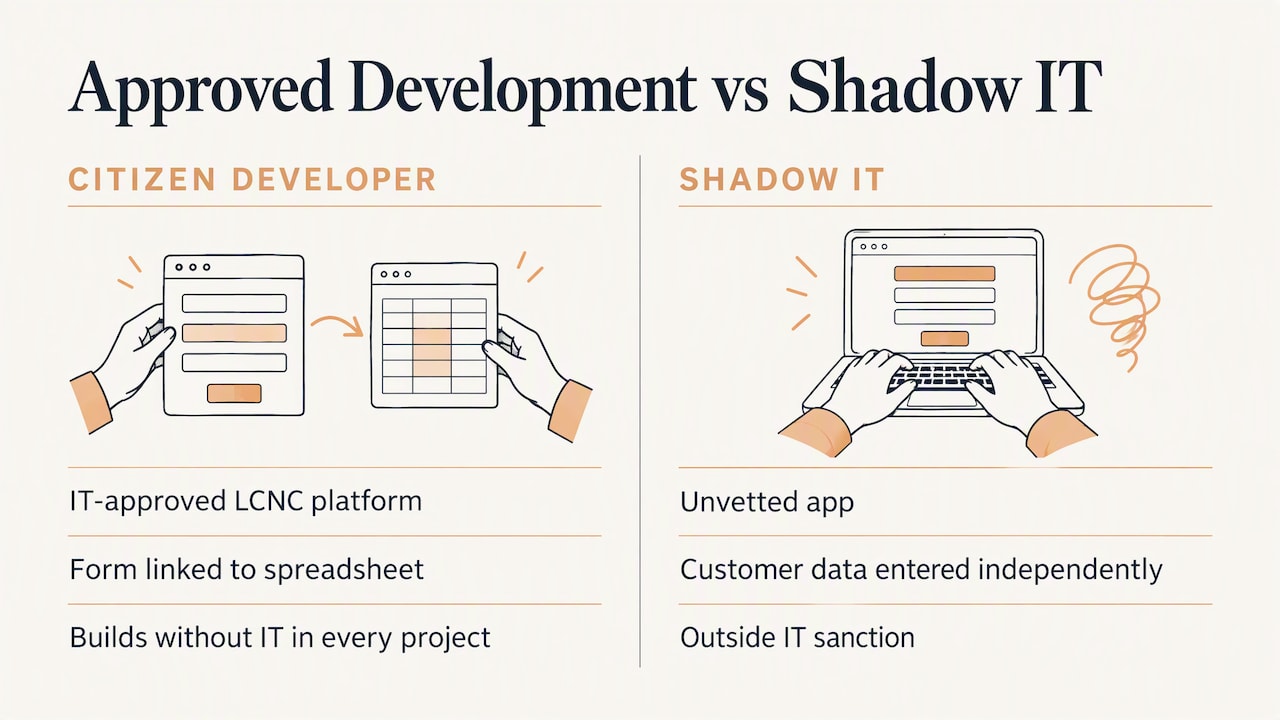
Two words in that definition matter most: sanctioned and business. A marketing manager who wires up a form to a spreadsheet using a tool IT has approved is a citizen developer. Someone who signs up for an unvetted app and pipes customer data into it on their own is doing something else, and that something else has a name: shadow IT.
The term is also not a job title. Pega describes a citizen developer as someone who can build applications without coding knowledge, usually with support from IT. It is a role people take on alongside their real job: an operations lead, a bookkeeper, a recruiter, a solo consultant.
Citizen developer vs. professional developer
The difference is not intelligence or effort. It is scope and accountability.
| Citizen developer | Professional developer | |
|---|---|---|
| Background | Business or operations role | Software engineering |
| Tools | Visual, drag-and-drop, low-code/no-code | Code, frameworks, infrastructure |
| Typical output | Workflows, forms, dashboards, simple apps, chatbots | Core systems, complex integrations, security-critical software |
| Strength | Deep knowledge of the process | Architecture, quality, scalability |
| Accountability | Their own team’s workflow | Systems the whole company relies on |
The two roles work best together. According to TechTarget, professional developers should provide oversight so quality, functionality, and security hold up. Pega adds that they can coach citizen developers and supply reusable components, while the citizen developers build the business workflows.
Who can become a citizen developer?
Anyone in a business who knows its processes and is willing to learn. That is the practical answer from SS&C Blue Prism, which notes that these people spot automation opportunities and build low-code or no-code automations to capture them.
In practice, the best candidates share a few traits:
- They feel the pain. They do the repetitive task every week and can describe each step.
- They are persistent. The U.S. General Services Administration advised in 2021 that agencies should assign development licenses carefully, to people with sustained motivation for citizen development rather than a passing curiosity.
- They document well. A process you can write down in numbered steps is a process you can automate.
- They accept review. Citizen developers who welcome a second pair of eyes produce safer work.
This is not limited to large companies. The U.S. Department of Veterans Affairs, for example, gives employees resources to build apps, automations, and chatbots with Microsoft Power Platform. At the other end of the scale, a self-employed consultant who automates their own intake emails and invoicing is a citizen developer of one.
What do citizen developers actually build?
Most projects are small, close to the work, and repetitive by nature. Common examples:
- Auto-responses and email sequences that reply to inquiries and follow up with leads.
- Lead capture from a website form or a chat widget into a CRM or spreadsheet.
- Approval workflows for time off, purchase requests, or expense reports.
- Dashboards that pull numbers from several tools into one view.
- Document handling, such as routing invoices for review. If this is your use case, our guide to invoice processing automation shows how the pieces fit.
- Social media scheduling and content calendars.
- Simple internal apps and chatbots for answering common staff questions.
If you are short on ideas, our automation ideas page lists workflows that small teams commonly start with. A reliable rule of thumb: pick a task that happens often, follows clear rules, and wastes a measurable amount of someone’s time.
What benefits can citizen development bring?
The Project Management Institute lists faster innovation, operating cost savings, and higher project team satisfaction among the benefits. The larger numbers come from companies that have scaled the practice:
- A Deloitte global survey, cited by MIT Sloan Management Review in 2023, found companies expected an average of more than 30% cost reduction on tasks they automated.
- The same MIT Sloan piece reports that AT&T’s citizen-developed automations saved roughly 270,000 hours a year, a 20-times return on investment.
- Microsoft reported in 2023 that one revenue processing tool built by a citizen developer produced about $14.2 million in annual savings.
These are large organizations with dedicated programs, so treat them as proof of what is possible, not a forecast for your team. The mechanism scales down well, though. A task that takes three hours a week costs about 150 hours a year. Automating even most of it gives that time back to work that grows the business.
Benefits by size of business
- Self-employed: You become your own operations department. Intake, scheduling, follow-up, and invoicing stop depending on your memory.
- Small teams: Everyone who owns a repeated task can improve it, so the owner stops being the bottleneck for every fix.
- Medium teams: Departments solve their own backlog instead of waiting in the IT queue.
- Enterprises: Business units build local automations while a central group sets standards, which is the model in the AT&T and Microsoft examples above.
What training does a citizen developer need?
The tools are easy to start with. The habits are what take training. According to MIT Sloan, citizen developers need training in the automation tools and in process-improvement methods, and most organizations surveyed offer programs that run 40 to 80 hours, sometimes with hackathons to build momentum.
SS&C Blue Prism adds two points: citizen developers should learn to build with simple drag-and-drop tools, and they should learn to work within governance frameworks. A solid curriculum, whether for a team of three or three thousand, covers:
- Process mapping. Writing down the current steps, owners, inputs, and exceptions before touching a tool.
- The approved platform. Triggers, actions, conditions, error handling, and how to test.
- Data handling. What data may be used, where it can go, and who may see it.
- AI adoption basics. When to use an AI agent or assistant inside a workflow, what to check in its output, and what must never be pasted into an unapproved tool.
- Documentation and handoff. Every automation needs a name, an owner, a description, and a plan for when its builder leaves or changes roles.
- When to escalate. Clear triggers for bringing in IT or an outside specialist.
A realistic training path
You do not need a 80-hour classroom block to begin. A workable pattern for a small team:
- Pick one painful, repetitive process.
- Map it together on a whiteboard.
- Build the first version with someone experienced beside you.
- Run it in test mode, fix what breaks, then switch it on.
- Write a half-page note on what it does and who owns it.
- Repeat with the next process, this time with less help.
That sequence teaches the tool, the discipline, and the review habit at the same time, and it produces a working automation by the end of the first session.
Risks and guardrails
Citizen development fails in predictable ways. MIT Sloan’s analysis says successful programs need leadership, coordination, and governance to prevent shadow IT and technical debt. In plain terms:
- Shadow IT. Tools and data flows nobody in IT or leadership knows about. If a customer list is being synced through an unvetted service, nobody is protecting it.
- Technical debt. An automation built in a hurry by someone who then changes jobs becomes a mystery that breaks at the worst moment.
- Duplicated effort. Three departments build three versions of the same workflow.
- Weak testing. A flawed automation can send the wrong email to a thousand people far faster than a person could.
The fix is not to ban the practice. It is a light set of rules. The GSA’s guidance suggests governance can include standardized protocols, code reviews, role-based access controls, and separate development, testing, and production environments. MIT Sloan’s experts also recommend clear policies and guardrails, plus certification of citizen-developed automations before they run for real.
A starter governance checklist
- A short list of approved platforms and connectors.
- A registry of every automation, with an owner and a purpose.
- Test before production, always, using sample data.
- Role-based access, so builders only touch the data they need.
- A review step for anything touching customer, financial, or personal data.
- A retirement rule: unused automations get switched off.
If you are not sure what is already running in your company, start by finding out. A practical shadow IT audit walks through how growing businesses can inventory the tools and workflows their people have quietly adopted, which is the natural first step before you formalize a citizen development program.
Where citizen development ends and specialist work begins
Citizen developers are best at workflows close to their own job. Some projects are a poor fit for a part-time builder:
- Anything that connects several core systems with complex logic.
- Workflows with legal, financial, or regulated data consequences.
- Customer-facing systems that must be available all day.
- Custom AI agents that need tuning, monitoring, and integration.
- Physical or in-person setups, such as lead-capture kiosks at events.
A good rule: if failure would be embarrassing, build it with help; if failure would be expensive or regulated, hand it to specialists. Our guide to hiring AI automation consulting covers what to ask for and how to judge an engagement.
Our perspective
We build custom automations for a living, and we see the same pattern in nearly every business we talk to. People already know which tasks eat their week. What they lack is a safe, structured way to fix them.
We think the healthiest model is a partnership. Your people stay close to the process, because nobody else understands it as well. We help with the parts that are hard to do part-time: choosing the right structure, connecting the tools, integrating AI agents, and making sure the result keeps working as the business changes.
That is why we offer consultations, custom training, and full automation setups side by side. Some clients want to learn to build and need a guide. Others want a done-for-you system and an owner who understands it. Both are legitimate, and many start with one and move to the other as they grow.
Our approach is tailor-made: systems calibrated to your growth stage, whether you are self-employed, a small team, or a larger operation. The goal is not to replace the citizen developer. It is to make that person far more effective, and to catch the mistakes that cost money.
Joshua
How we help
If you want to train your team, or skip straight to a working system, we offer consultations, custom help, and done-for-you setups. Our automation services cover auto-responses, automatic emails, lead generation and capture, social media, advertising, and search and media optimization.
For ongoing automation, the Elevator Pitch Automations Unlimited plan is $300 per month, and you can start it on our setup page. Other services, including hardware and systems, are described on the pricing page. To see what we have already built, browse our automations, or get in contact to talk through your first project.
How to start in your own business
A practical first month:
- Week 1: list. Ask everyone to write down three tasks they repeat weekly and how long each takes.
- Week 2: score. Rank by hours saved, frequency, and risk. Pick the top one that is low risk.
- Week 3: build and test. Use an approved platform, sample data, and a reviewer. Our how to automate page is a good primer.
- Week 4: launch and record. Switch it on, log it in your registry, and measure the hours saved against your baseline.
Then decide, with evidence in hand, how far to take it. If the first automation gave you back a few hours a week, the second will be easier, and the third will be easier still.
FAQ
What is the difference between a citizen developer and a citizen development program?
A citizen developer is the person who builds. Citizen development is the organized practice around them: approved tools, training, governance, and support from IT. A company can have people building on their own without a program, but that is usually how shadow IT starts.
Do you need to know how to code to be a citizen developer?
No. Low-code and no-code platforms give non-technical users visual interfaces for building applications, as TechTarget explains. You do need to understand your process, learn the tool, and follow your company’s rules for data and review.
How long does citizen developer training take?
MIT Sloan reports that most organizations surveyed run programs of 40 to 80 hours. Small teams can begin much sooner by learning on one real workflow with an experienced guide, then adding skills project by project.
Should a small business train employees or hire someone to build automations?
It depends on the job. Simple, low-risk workflows suit trained employees. Complex integrations, AI agents, and anything touching sensitive data are better built by specialists, ideally who also train your people to own the result.
Sources
- What Is Citizen Development? (TechTarget)
- What is a Citizen Developer? (Pega)
- What is a Citizen Developer? (SS&C Blue Prism)
- Citizen Developer (DigitalVA Product Marketplace)
- 5 Tips for Implementing Citizen Development in Your RPA Program (Digital.gov)
- Harnessing Grassroots Automation (MIT Sloan Management Review)
- Citizen Developer (Project Management Institute)
- Empowering and Securing our Citizen Developers (Microsoft Inside Track)